
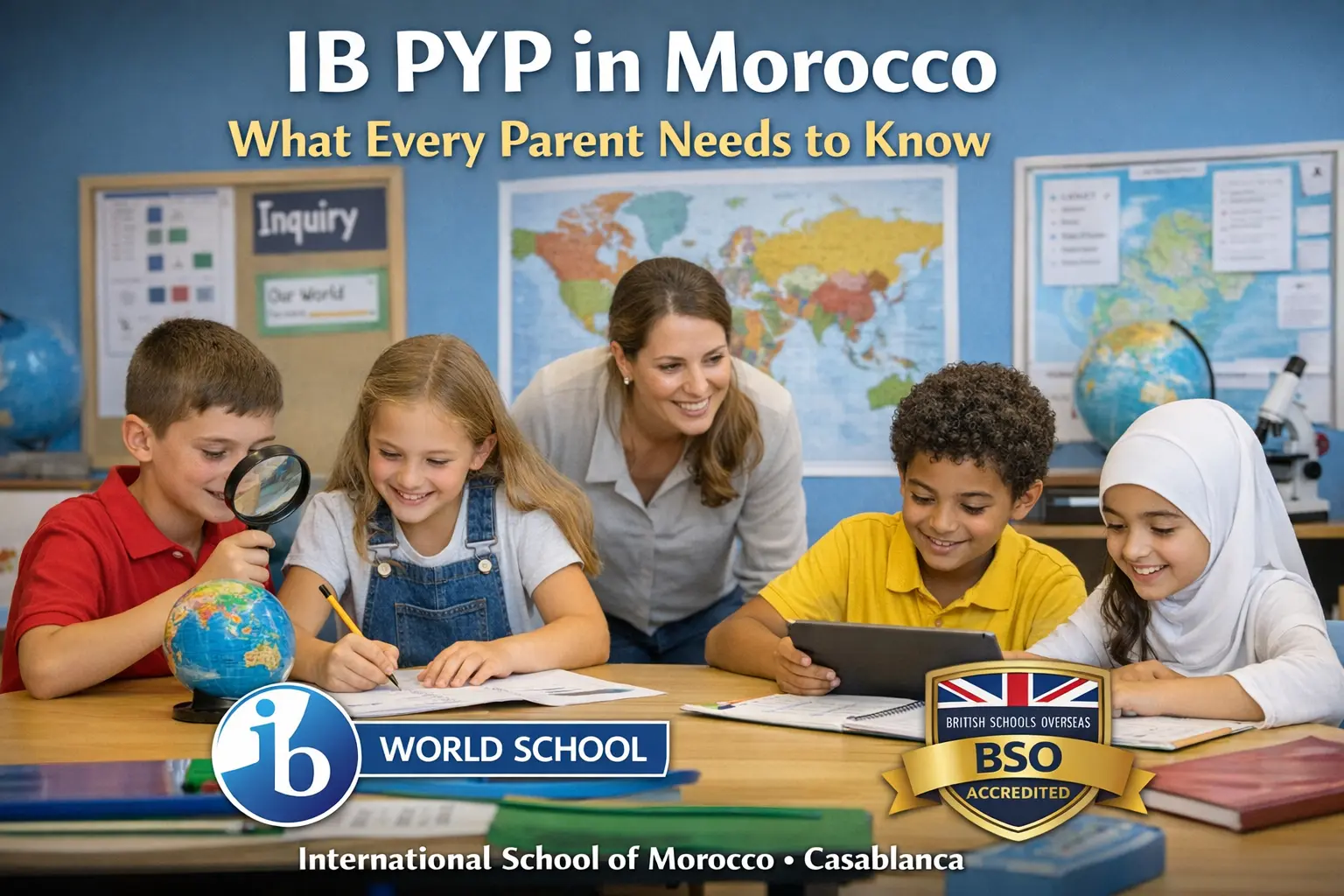
If you have been researching schools in Morocco, you have almost certainly seen the letters IB PYP in a school’s description. They appear on websites, in admissions brochures, and in conversations among parents. Yet for many families, what those letters mean in practice, inside a real classroom, for a real child, remains unclear.
That gap matters, because the IB PYP is not a marketing label. It is a specific, independently verified curriculum framework with a defined approach to teaching, learning, and child development. Understanding it properly helps you ask the right questions when choosing a school and recognise the difference between a school that is genuinely authorized to deliver the IB PYP and one that simply claims to be inspired by it.
This guide covers what the IB Primary Years Programme is, how it works in the classroom, what the research says about its outcomes, and why ISM in Casablanca is one of the few schools in Morocco that holds both IB World School authorization and British Schools Overseas (BSO) accreditation simultaneously.
What Is the IB PYP?
The IB Primary Years Programme (PYP) is an internationally recognized curriculum framework for children aged 3 to 12. It is developed and maintained by the International Baccalaureate Organization, a non-profit educational foundation based in Geneva, Switzerland, and currently offered in over 1,700 schools across more than 100 countries.
At its core, the PYP is built on one idea: children learn better when they are active participants in the learning process, not passive receivers of information. Rather than asking students to memorize facts and repeat them in tests, the PYP asks them to question the world around them, investigate ideas, and build their own understanding. This approach, called inquiry-based learning, shapes every aspect of how the programme is designed and delivered.
IB World School Authorization: What It Actually Means
A school cannot simply decide to “follow the IB PYP” and call itself an IB school. To use that title, a school must complete a rigorous multi-year authorization process with the IB Organization, during which its curriculum, teaching approach, professional development practices, and student outcomes are independently evaluated.
Once authorized, a school becomes an IB World School and undergoes ongoing review to maintain that status. The IB Organization publishes an official school finder where families can verify any school’s authorization directly. This distinction matters greatly in Morocco, where some schools describe themselves as “IB-aligned” or “IB-inspired” without having completed formal authorization.
According to the IB Organization’s Africa overview, Morocco has 15 IB World Schools, the second-highest number in Africa after Egypt. Not all of these offer the PYP. Families specifically seeking primary-level IB education need to verify that authorization covers the PYP for children aged 3 to 12.
How IB PYP Learning Works: Inside the Classroom
The Six Transdisciplinary Themes
Rather than separating learning into isolated subjects, the IB PYP organizes teaching around six transdisciplinary themes. These are big, real-world questions that connect mathematics, language arts, science, and social studies simultaneously. The themes are:
- Who We Are: identity, beliefs, personal health, and human relationships
- Where We Are in Place and Time: history, exploration, migration, and discovery
- How We Express Ourselves: creativity, culture, and communication
- How the World Works: science, nature, and how systems function
- How We Organize Ourselves: communities, decision-making, and systems
- Sharing the Planet: rights, resources, and living alongside others
In practice, a primary student might spend several weeks exploring “How the World Works” by conducting a science experiment, recording data in mathematics, writing up their findings in English, and presenting conclusions to the class. Every subject connects to the same central question. This is what inquiry-based learning looks like when it is built into the structure of a curriculum, not just added as an occasional activity.
What a Real PYP Lesson Looks Like
In a traditional classroom, a lesson on habitats might begin with a teacher explaining the definition from a textbook, followed by exercises to check comprehension. In a PYP classroom, the same topic begins with a provocation. That could be an image, a short video, or a question that invites children to wonder. Students then generate their own questions, work in small groups to investigate, and build understanding through discussion and evidence rather than being told the answer.
Teachers in a PYP school act as guides and facilitators, not as the primary source of all information. According to the IB Organization’s PYP curriculum documentation, “PYP learners know how to take ownership of their learning, collaborating with teachers to deepen understanding and increase their confidence and self-motivation.” At ISM, small class sizes make this genuinely possible. Teachers know every student well enough to track individual progress and give targeted support.
The PYP Exhibition: The Programme’s Signature Capstone
Each IB PYP journey culminates in the PYP Exhibition, a student-led project where children independently investigate a real-world issue they care about, carry out their own research, and present their findings to the broader school community.
Children as young as ten or eleven regularly choose topics such as food waste, access to clean water, or community belonging. They design the investigation themselves, gather evidence, and draw their own conclusions. The Exhibition demonstrates, in a visible and meaningful way, what inquiry-based learning produces over time: children who can think independently, communicate clearly, and take genuine ownership of their learning.
IB PYP in Morocco: The Landscape for Parents
15 IB World Schools and What the Numbers Mean
Morocco’s 15 IB World Schools represent one of the strongest IB presences in Africa, according to the IB World Schools Yearbook. These schools are clustered around Casablanca, Rabat, Marrakech, and Tangier, and they span different programmes. Some schools offer the IB Middle Years Programme (MYP) for secondary students. Others are authorized for the full IB Diploma. Only a subset are authorized to deliver the IB PYP for children from early years through primary school.
For parents of primary-age children, the relevant question is not simply whether a school has any IB connection, but specifically whether it holds current authorization for the PYP covering ages 3 to 12.
Authorized vs. “IB-Inspired”: Why the Difference Matters
A number of schools in Morocco use IB-adjacent language in their communications without holding current IB World School authorization. Terms like “IB-inspired,” “based on IB principles,” or “following the IB approach” do not carry the same meaning as verified authorization.
Authorization means the IB Organization has independently evaluated the school’s curriculum delivery, teacher training, and student outcomes against its global standards. The simplest way to verify a school’s status is through the IB Organization’s official school finder, which lists every currently authorized school worldwide.
Why ISM’s Dual BSO and IB Accreditation Is Rare
The International School of Morocco holds both IB World School authorization for the PYP and British Schools Overseas (BSO) accreditation from the UK Department for Education. That combination is genuinely rare in Morocco and across North Africa.
BSO accreditation means ISM has passed independent inspection to the same standards applied to schools in England, covering teaching quality, curriculum delivery, safeguarding, and pastoral care. As explained in our guide to what makes a British school in Casablanca different, ISM has held BSO status since 2011, making it the first BSO-accredited school in Morocco. The dual accreditation means ISM meets two entirely separate sets of international standards simultaneously, something very few primary schools in the region can say.
What Research Says About IB PYP Outcomes
Academic Performance Data
Research on IB PYP outcomes consistently points to stronger academic results compared to non-IB peers. A study conducted from 2009 to 2011, referenced by PrepScholar’s IB PYP review, found that PYP students performed better in mathematics, reading, and writing than students in non-IB programmes. A separate analysis by the University of Cambridge found similar patterns, attributing the gains to the PYP’s integrated, cross-disciplinary approach to building understanding rather than memorizing content.
According to Wikipedia’s IB Primary Years Programme entry, the philosophy of the PYP encourages students to become “inquirers, thinkers, communicators, risk takers, knowledgeable, principled, caring, open-minded, well-balanced, and reflective.” These ten attributes are known collectively as the IB Learner Profile.
Critical Thinking and Long-Term Learning Skills
What the data reflects in practice is that children educated through the PYP develop habits of mind including questioning, investigating, and reflecting that help them long after primary school. Because the PYP teaches children how to learn, not just what to learn, those skills transfer across subjects and contexts.
Children who have grown up constructing their own understanding, presenting their work, and taking responsibility for their learning are significantly better prepared for the rigour of secondary school, the IB Middle Years Programme, and ultimately higher education, regardless of where in the world they pursue it.
IB PYP vs. Traditional Curriculum: A Clear Comparison
Many parents comparing the IB PYP to other options in Morocco want a direct side-by-side view. Here is how the two approaches differ across the dimensions that matter most:
| Area | Traditional Curriculum | IB PYP |
|---|---|---|
| Learning approach | Teacher-led content delivery | Student-led inquiry and investigation |
| Subjects | Taught separately | Connected through transdisciplinary themes |
| Assessment | Tests and grades | Ongoing teacher observation, reflection, and portfolios |
| Student role | Passive receiver of information | Active constructor of knowledge |
| Goals | Academic content mastery | Whole-child development plus academic foundation |
This does not mean the IB PYP is less rigorous academically. Literacy and numeracy are central to the programme, and BSO-accredited schools like ISM are held to UK-standard academic benchmarks through independent inspection. The difference is in how those foundations are built, through inquiry, application, and genuine understanding rather than repetition and recall. For a deeper look at how this approach works in practice, visit ISM’s Primary Years Programme curriculum page.
Is IB PYP Right for Your Child?
The IB PYP works well for children of all learning styles precisely because it is designed around the natural way children learn, through curiosity, exploration, and connection-making.
Expat Families Relocating to Casablanca
For families arriving in Morocco from the UK, Europe, the Middle East, or elsewhere, the IB PYP provides curriculum continuity. A child transferring from an IB PYP school in London, Dubai, or Singapore will encounter the same transdisciplinary framework, the same Learner Profile attributes, and a familiar teaching philosophy. The academic adjustment is minimal, freeing the child’s energy for the more demanding work of settling socially into a new city and community.
Moroccan Families Investing in Global Options
For Moroccan families, an IB PYP education builds the specific skills that international universities increasingly look for: the ability to think independently, research effectively, communicate with clarity, and work across disciplines. Combined with English as the language of instruction, ISM’s IB PYP programme gives children the academic foundation to apply to universities in the UK, the US, France, Canada, and beyond.
If you are still weighing your options, our guide to how to choose an international school in Casablanca covers the full range of factors, from accreditation and curriculum to class sizes and pastoral care, to help you make a confident decision.
Frequently Asked Questions
1. What age group does the IB PYP cover?
The IB Primary Years Programme is designed for children aged 3 to 12, covering Early Years through the end of primary school. At ISM, the PYP is delivered across this full age range. More details are available on ISM’s Primary Years curriculum page.
2. How many IB PYP schools are there in Morocco?
Morocco has 15 IB World Schools in total, according to the IB World Schools Yearbook. Not all of these offer the PYP at primary level. Some are authorized for the MYP or Diploma Programme only. Families should verify specifically that a school holds PYP authorization using the IB Organization’s official school finder.
3. What is the PYP Exhibition and why does it matter?
The PYP Exhibition is the culminating project of the IB Primary Years Programme. Students independently investigate a real-world issue they care about, conduct their own research, and present their findings to the school community. It is the clearest demonstration of what years of inquiry-based learning produces: a child who can think independently, communicate effectively, and take full ownership of their learning.
4. How do I verify a school is truly IB-authorized and not just “IB-inspired”?
The most reliable method is to check the IB Organization’s official school finder, which lists every currently authorized IB World School worldwide. Any school that is genuinely authorized will appear there. Schools using language like “IB-inspired” or “based on IB principles” without appearing on this list have not completed the formal authorization process.
5. How can I see ISM’s IB PYP programme in action?
The best way to understand what the IB PYP looks like in practice is to visit the school. ISM welcomes prospective families for school visits. You can start the conversation through ISM’s admissions page, call directly at 05 22 99 39 87, or email info@ism-c.ma to arrange a visit and speak with the team.
The Bottom Line for Parents in Morocco
The IB PYP is not a brand name or a curriculum trend. It is a rigorously developed, independently verified approach to primary education that has been proven, across research and across more than 100 countries, to build stronger academic outcomes and better long-term learning habits.
In Morocco, not every school that mentions the IB holds genuine authorization. Families who understand what authorization actually means, and who look for schools where it is combined with strong pastoral care, small class sizes, and experienced teachers, are in the best position to choose well.
At ISM in Casablanca, the IB PYP sits alongside British Schools Overseas accreditation, small classes, English-medium instruction, and a genuinely multicultural community. That combination gives children not just an excellent primary education, but the foundation they need to thrive wherever the future takes them.
Ready to find out more? Visit ISM’s admissions page or contact the team to arrange a school visit.
