
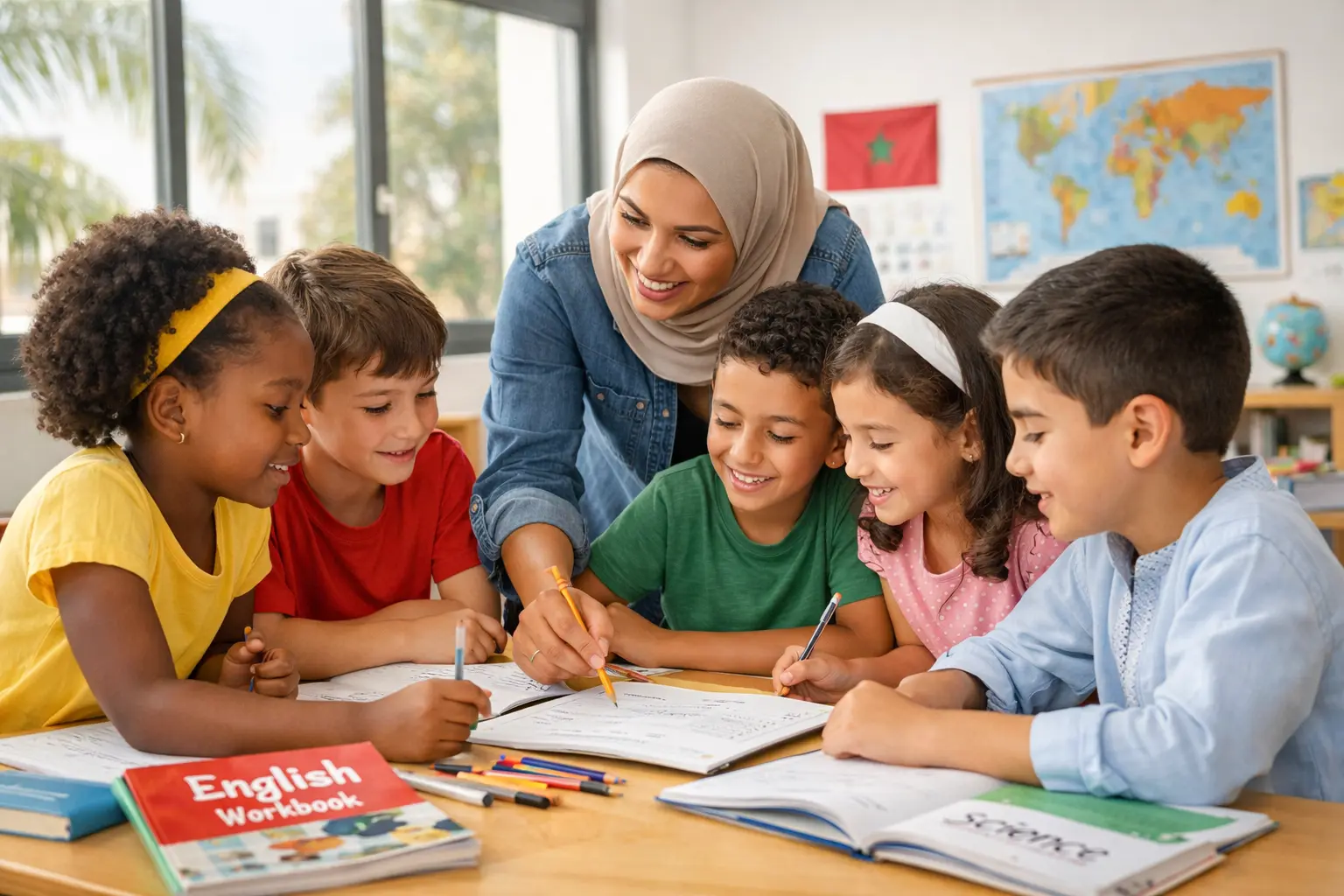
Choosing the right language of instruction for your child is one of the biggest decisions a parent can make. And in Morocco, more families are now looking at English medium education as a path to stronger academic outcomes and better career options.
According to Ethnologue and Statista (2023), around 1.52 billion people worldwide speak English, making it the most spoken language on the planet. For families in Casablanca and across Morocco, enrolling children in an English school in Casablanca means giving them early access to the world’s most widely used language for business, science, and technology.
But the benefits of English medium education go well beyond language skills alone. Let’s look at what the research says, and why it matters for your child’s future.
What Is English Medium Education?
English medium education, often called English Medium Instruction (EMI), refers to a system where English is the primary language used to teach academic subjects. Instead of learning English only as a foreign language class, children study subjects like mathematics, science, and social studies in English.
This approach is growing fast around the world. The British Council reports that about 94% of research in high-impact international publications is written in English. This means that students educated in English can access the latest knowledge in nearly every academic field without language barriers.
At the International School of Morocco, English medium education is delivered through the International Baccalaureate Primary Years Programme (IB PYP) combined with British School Overseas standards. Children learn to communicate, think, and create in English from their earliest school years.
Academic and Cognitive Benefits of Learning in English
Stronger Critical Thinking and Problem-Solving Skills
When children learn in a language different from their home language, their brains work harder to process information. Research published by the National Institutes of Health (NIH) shows that bilingual children often outperform monolingual peers in tasks that require attention, task-switching, and conflict management.
This is because managing two languages trains the brain’s executive function, the system responsible for planning, focusing, and solving problems. Children in English medium schools develop these skills naturally through daily classroom activities.
At ISM, inquiry-based learning encourages children to ask questions, investigate topics, and think through problems independently. This approach builds critical thinking from an early age.
Better Reading Comprehension and Communication
English is one of the most content-rich languages. Over 52% of all websites feature content in English, according to language statistics compiled in 2024. Children who learn to read, write, and communicate in English gain access to a massive amount of educational resources, books, and digital content that is simply not available in other languages at the same scale.
English medium education builds strong literacy foundations. Children learn to summarize information, write reports, and express ideas clearly. These skills transfer across all subjects and stay with them throughout their academic careers.
Cognitive Flexibility and Multilingualism
One of the most exciting findings in education research is the connection between bilingualism and cognitive flexibility. A study from Bialystok and colleagues found that bilingual children showed smaller “switch costs” on cognitive tasks compared to monolingual children, regardless of which languages they spoke.
For Moroccan children who already speak Arabic or French at home, adding English through school creates a multilingual advantage. They learn to move between languages and cultural contexts with ease. ISM’s Languages and Communication programme is designed to support both native English speakers and English language learners, building fluency and confidence in a supportive environment.
Career and Economic Advantages of English Medium Education
Access to Global Job Markets
English is the language of international business, and the numbers confirm it. A survey cited by Simon & Simon (2025) found that 98.5% of employers in 38 countries assess candidates’ English skills during the hiring process. Half of those employers offer better starting packages to candidates with strong English ability.
Workers with solid English skills in developing economies can earn 25 to 35% more than peers with similar qualifications but limited English. For Moroccan students, this wage premium makes English medium education one of the most practical investments parents can make.
Preparation for International Higher Education
Most of the world’s top-ranked universities teach in English. Students who have been educated in English from primary school have a clear advantage when applying to universities in the UK, US, Canada, Australia, and across Europe. They already have the academic vocabulary and writing skills required for higher education, while others may need to take additional language courses.
ISM’s British curriculum is accredited by the UK Department for Education, which means it meets the same standards as schools in Britain. This accreditation makes the transition to British or international secondary schools and universities much smoother.
The Growing Demand for English in Morocco
Morocco itself is moving toward English. According to a 2022 British Council report, 40% of young Moroccans between the ages of 15 and 25 believe English is the most important language to learn, compared to only 10% for French.
The Moroccan Ministry of Education has already begun rolling out plans to teach English in middle schools starting from 2023-2024, with the goal of making English a core part of the national curriculum by 2030. Families who choose English medium education now are giving their children a head start that aligns with where the country is heading.
Social and Cultural Benefits of English Medium Schools
Developing a Global Perspective
Children in English medium schools interact with international content, ideas, and cultures every day. They read books from around the world, discuss global issues, and learn to see things from different points of view.
This global mindset is not just nice to have. It prepares children for life in a connected world where understanding different cultures is a real professional and personal advantage. At ISM, the international community of families, including both expat and local Moroccan families, creates a natural environment for cultural exchange and global awareness.
Building Confidence and Independence
Learning in English challenges children in healthy ways. They develop resilience as they work through new vocabulary and concepts. Over time, they gain the confidence to express themselves fluently in what is often a second or third language.
Small class sizes play an important role here. When teachers can give individual attention to each child, students feel supported enough to take risks, ask questions, and grow. ISM keeps class sizes small so that every child gets the guidance they need.
Stronger Social and Emotional Skills
Research from the Encyclopedia on Early Childhood Development shows that bilingual children tend to be more sensitive to the communication needs of others. They develop a better understanding of different perspectives earlier than monolingual children.
In an English medium school setting, children practice empathy, teamwork, and communication daily. These social-emotional skills are just as important as academic achievement for long-term success.
How to Choose the Right English Medium School in Morocco
Not all English medium schools are the same. Here are the key things to look for when choosing a school for your child:
Accreditation matters. Look for schools with recognized international accreditation. ISM is the first school in Morocco to earn British School Overseas (BSO) accreditation, verified by UK Ofsted standards.
Curriculum quality counts. A strong curriculum like the IB PYP gives children a well-rounded education that goes beyond memorizing facts. It builds inquiry skills, creativity, and independent thinking.
Teacher qualifications are key. Experienced, British-trained educators who understand child-centered learning make a real difference. ISM’s qualified international teaching staff brings global experience to the classroom.
Community and support. A welcoming school community where parents feel involved and children feel safe creates the best conditions for learning. ISM’s nurturing environment supports both local and expat families in Casablanca.
For a detailed guide on what to look for, see our full article on how to choose an international school in Casablanca.
Frequently Asked Questions
1. At what age should children start English medium education?
The earlier children are exposed to English as a language of instruction, the more naturally they pick it up. Research shows that children’s brains are most flexible for language learning between ages 0 and 8. Starting English medium education at the primary level, as ISM offers from age 3, gives children the best chance to develop fluency without the stress of learning a new language later.
2. Will English medium education affect my child’s Arabic or French skills?
No. Research consistently shows that children educated in two or more languages do not fall behind in their home language. In fact, the cognitive skills developed through bilingual education, such as better attention and mental flexibility, support learning in all languages. ISM supports multilingualism and provides a balanced approach that respects children’s home languages.
3. Is English medium education recognized by Moroccan universities?
Yes. English is increasingly accepted and even preferred in many Moroccan higher education programmes, especially in science, technology, business, and economics. Morocco’s Ministry of Education is actively working to expand English instruction across the national school system. Students from English medium schools are well prepared for both Moroccan and international university pathways.
4. What is the difference between English medium education and just taking English classes?
In English medium education, English is the language used to teach all or most subjects, not just a standalone class. This means children use English for math, science, social studies, and the arts. This deeper exposure builds real fluency and academic vocabulary, while a standalone English class typically covers only basic language skills.
5. How does ISM support children who are new to English?
ISM provides dedicated support for English language learners through its Languages and Communication programme. Small class sizes allow teachers to give personalized attention, and the inquiry-based learning environment encourages children to learn by doing. Most children become confident English communicators within the first year.
Ready to give your child the benefits of English medium education? Apply to the International School of Morocco or contact us to schedule a visit and see our community in action.
