
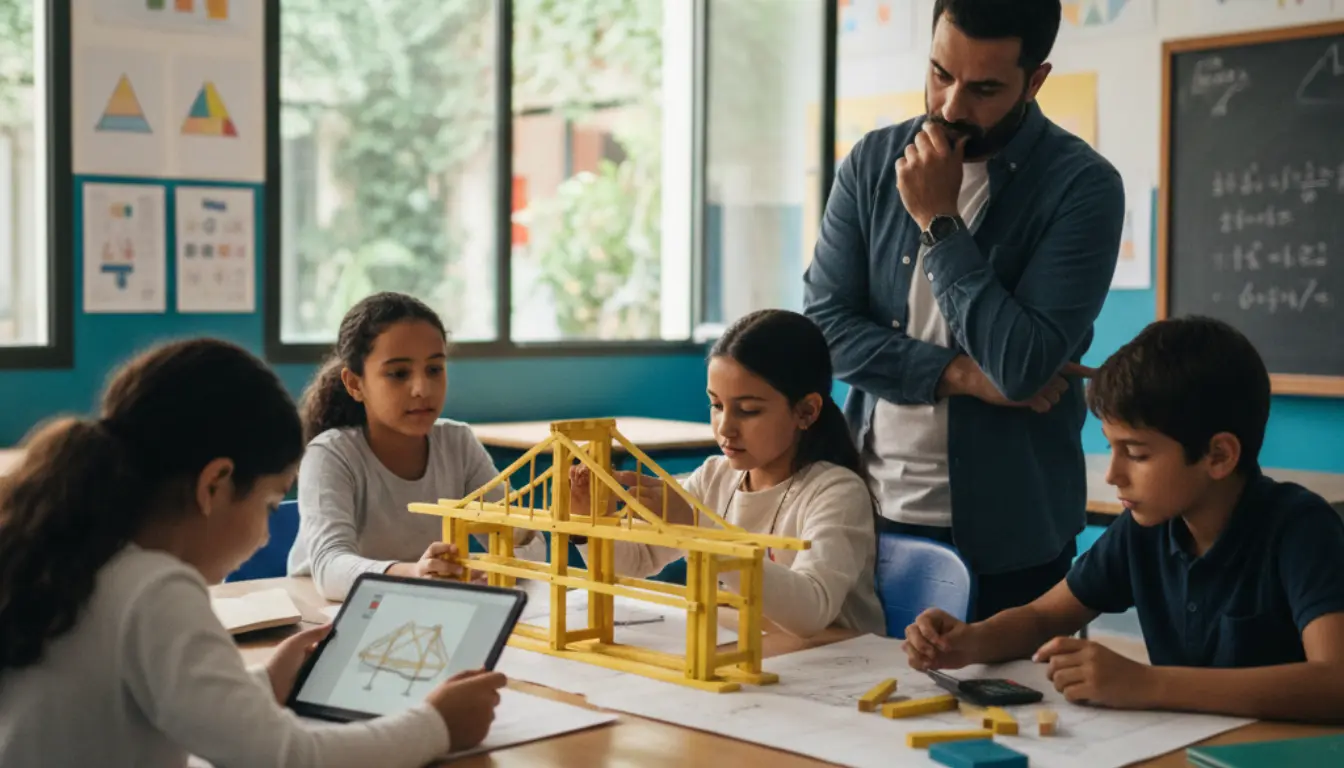
Inquiry-based learning represents a fundamental shift in how children engage with education. Rather than passively receiving information, students become active participants, driving their own discoveries through questions, exploration, and hands-on investigation. This student-centered approach transforms classrooms into dynamic environments where curiosity leads to deeper understanding and genuine intellectual growth. For parents and educators in Morocco seeking educational excellence, understanding what is inquiry-based learning provides crucial insight into modern pedagogical methods that prepare children for an increasingly complex, interconnected world.
The distinction between inquiry-based learning and traditional teaching methods goes beyond superficial differences in classroom management. At its core, this approach recognizes that children construct knowledge most effectively when they pursue answers to their own questions rather than memorizing facts presented by teachers. Schools implementing inquiry-based learning methods, such as the International School of Morocco, demonstrate how this philosophy creates self-motivated, independent learners capable of navigating challenges well beyond their school years.
This comprehensive guide explores the principles of inquiry-based learning, its proven benefits, practical implementation strategies, and real-world applications across subjects. Whether you’re an educator considering this approach or a parent evaluating educational options in Casablanca, this resource provides the understanding needed to recognize and appreciate truly transformative education.
Defining Inquiry-Based Learning Basics
Core Principles of Student-Driven Inquiry
Inquiry-based learning operates on the fundamental premise that students learn most effectively when they actively construct knowledge through observation, investigation, and problem-solving. This constructivist method draws from educational theorists who recognized that genuine learning occurs not through passive reception but through active engagement with questions and challenges. The approach transforms students from recipients of information into researchers, investigators, and knowledge builders.
At institutions like ISM, inquiry-based learning means students guide their teachers rather than the reverse. Children ask the questions they genuinely want answered, creating immediate investment and engagement in the learning process. Teachers act as facilitators—providing structure, resources, and guidance while students discover and construct their own understanding. This represents a fundamental reconceptualization of the teacher-student relationship, positioning educators as partners in discovery rather than sources of absolute knowledge.
The principles of inquiry-based learning in modern education emphasize several key elements: student agency in determining learning directions, authentic investigation using real-world resources and methods, collaborative exploration where learners support each other’s discoveries, and reflection that helps students understand not just what they’ve learned but how they learned it. These principles work together, creating educational experiences that mirror how humans naturally learn outside formal schooling contexts.
Inquiry-Based Learning vs Traditional Teaching
Understanding the differences between inquiry-based and traditional approaches clarifies why this methodology produces such distinctive outcomes:
| Aspect | Traditional Teaching | Inquiry-Based Learning |
|---|---|---|
| Teacher Role | Primary information source, lecturer | Facilitator, guide, learning partner |
| Student Role | Passive recipient, listener | Active explorer, questioner, researcher |
| Learning Process | Teacher presents, and students absorb | Students question, investigate, and discover |
| Knowledge Source | Textbooks, teacher explanations | Multiple resources, experimentation, research |
| Motivation | External (grades, compliance) | Intrinsic (curiosity, personal interest) |
| Assessment Focus | Recall of presented information | Understanding, application, and inquiry skills |
| Classroom Dynamic | Teacher-centered, uniform pace | Student-centered, differentiated exploration |
| Learning Outcomes | Memorization, short-term retention | Deep understanding, critical thinking, retention |
This contrast reveals why inquiry-based learning produces learners capable of independent thinking and problem-solving. When students at ISM focus on their own questions rather than questions imposed by teachers, they become invested and genuinely interested in their learning. This engagement stems from authentic ownership of the learning process—students chose the topic, they’re searching for answers themselves, and they’re constructing meaning that matters to them personally.
Discover how the International School of Morocco’s curriculum applies these inquiry-based principles through the IB PYP framework, creating engaging, creative learning experiences that equip children with skills, knowledge, and confidence to succeed globally.
Levels of Inquiry from Structured to Open
Inquiry-based learning exists along a continuum, with different levels appropriate for various developmental stages, subjects, and learning objectives:
- Confirmation Inquiry: Students confirm principles through activities where both question and answer are provided. Teachers guide step-by-step verification of known concepts, helping learners develop basic inquiry skills and scientific thinking processes.
- Structured Inquiry: Teachers provide questions and procedures, but students generate explanations from evidence they gather. This level builds confidence in the inquiry process while maintaining clear scaffolding for developing investigators.
- Guided Inquiry: Teachers pose questions, but students design investigations and develop explanations independently. This represents significant student autonomy while maintaining teacher support in formulating the initial inquiry direction.
- Open Inquiry: Students formulate questions, design investigations, and develop explanations independently. This highest level mirrors authentic scientific and academic research, with students driving the entire inquiry process from conception through conclusion.
ISM’s approach recognizes that effective inquiry-based learning often moves students progressively through these levels. Younger children might engage primarily with structured and guided inquiry, while older students in programs like the Year 6 Exhibition demonstrate sophisticated open inquiry capabilities, exploring multiple perspectives, synthesizing learning, and taking action based on their discoveries.
Key Benefits for Students and Teachers
Boosting Critical Thinking and Problem-Solving
The benefits of inquiry-based learning on critical thinking skills extend far beyond immediate academic achievement. When students engage in authentic investigation, they develop higher-order thinking capabilities essential for navigating complex, ambiguous situations throughout life. Rather than accepting presented information at face value, inquiring learners evaluate evidence, consider multiple perspectives, identify patterns, and draw reasoned conclusions based on available data.
This enhanced critical thinking emerges naturally from the inquiry process itself. Students asking genuine questions must determine what information they need, evaluate source reliability, synthesize findings from multiple resources, identify contradictions or gaps, and construct coherent understanding from complex, sometimes conflicting evidence. These are precisely the skills demanded by university-level study, professional work, and informed citizenship—yet they’re difficult to develop through traditional, teacher-centered instruction where correct answers are simply provided.
Problem-solving abilities strengthen similarly. Inquiry-based learning confronts students with authentic challenges requiring creative solutions rather than application of memorized procedures. At ISM, this might involve Units of Inquiry where children explore real-world issues, connect learning to UN Sustainable Development Goals, and develop action-oriented responses. Such experiences teach students that problems rarely have single correct solutions, that investigation and iteration lead to better outcomes, and that collaborative thinking often produces insights no individual could reach alone.
Increasing Engagement and Motivation
Perhaps the most immediately visible benefit of inquiry-based learning is dramatically increased student engagement. When children pursue answers to their own questions, the learning becomes intrinsically meaningful rather than merely a requirement for grades or teacher approval. This shift from external to internal motivation transforms classroom dynamics, creating environments where students eagerly participate, persist through challenges, and extend learning beyond formal lesson times.
The connection to real-world contexts amplifies this engagement. Inquiry-based learning encourages students to explore questions relevant to their lives, communities, and interests. At ISM, this might involve investigating local biodiversity, exploring Moroccan cultural heritage, or examining global issues through locally relevant lenses. These authentic connections help students understand that learning serves purposes beyond school itself—it provides tools for understanding and improving the world around them.
For Morocco’s diverse, multilingual educational settings, this engagement advantage proves particularly valuable. Students bringing different cultural backgrounds, language experiences, and prior knowledge can all find meaningful entry points into inquiry. A child’s unique perspective becomes an asset rather than a challenge, as diverse viewpoints enrich collective investigation and understanding.
Developing Deeper Knowledge Retention
Research consistently demonstrates that inquiry-based learning produces superior long-term knowledge retention compared to traditional instruction. This outcome makes intuitive sense: information students discover through their own investigation embeds more deeply than facts presented by teachers. The active construction of understanding creates stronger neural pathways and richer conceptual frameworks than passive reception ever could.
Several mechanisms contribute to this enhanced retention:
- Active processing: Students engaging with material through multiple modalities (reading, discussing, experimenting, creating) develop more robust understanding than those merely listening
- Personal meaning: Self-directed inquiry connects new learning to existing knowledge and interests, creating meaningful associations that aid memory
- Emotional engagement: The excitement of discovery and satisfaction of solving genuine problems creates emotional markers that enhance recall
- Repeated exposure: Investigation typically involves encountering key concepts multiple times in various contexts, strengthening retention through distributed practice
- Teaching others: Collaborative inquiry often requires students to explain thinking to peers, which deepens their own understanding through articulation
Beyond individual retention, inquiry-based learning fosters collaboration and develops lifelong learning habits. Students learn that knowledge construction is often collaborative, that diverse perspectives enhance understanding, and that questioning and investigation are ongoing processes rather than one-time events. These habits prepare learners for continuous growth and adaptation throughout their lives.
Explore how ISM’s inquiry-focused curriculum develops these deeper learning outcomes through the International Baccalaureate Primary Years Programme framework.
Step-by-Step Implementation Guide
Generating Compelling Student Questions
Effective inquiry-based learning begins with questions that genuinely intrigue students and merit sustained investigation. This crucial first step often challenges educators accustomed to providing rather than eliciting questions. Several strategies support this shift:
- Start with complex, open-ended problems: Present scenarios, phenomena, or challenges with multiple facets rather than single correct answers. Real-world situations work particularly well—local environmental concerns, community issues, or intriguing natural phenomena.
- Use the Question Formulation Technique (QFT): Provide a question focus (statement, image, or scenario) and have students generate as many questions as possible without evaluation. Then collaboratively categorize questions (closed vs. open), refine them, and prioritize which to investigate.
- Build on student interests and experiences: Connect inquiry topics to students’ lives, cultures, and curiosities. At ISM, this might involve exploring aspects of Moroccan heritage, local ecology, or issues students encounter in their diverse, international community.
- Model questioning: Demonstrate your own wondering and curiosity. Share genuine questions you have about topics, showing that questioning is a sophisticated intellectual practice, not a sign of ignorance.
- Create a culture of inquiry: Establish classroom norms where all questions are valued, where “I don’t know, let’s find out” is an acceptable response, and where curiosity is celebrated as much as knowledge.
At ISM, this question-generation process reflects the school’s philosophy that pupils guide teachers by asking questions they genuinely want answered. This student ownership creates the investment and motivation that makes sustained inquiry possible.
Research and Information Gathering Strategies
Once compelling questions emerge, students need support navigating the research and information-gathering phase. How to implement inquiry-based learning research phase effectively requires careful scaffolding:
Provide diverse, accessible resources: Make available books, articles, videos, websites, expert contacts, and hands-on materials appropriate to students’ ages and reading levels. For international schools in Morocco, this might include resources in multiple languages and from various cultural perspectives.
Teach source evaluation skills: Help students assess information reliability, identify bias, recognize expertise, and distinguish fact from opinion. These critical literacy skills prove essential in our information-saturated world where misinformation spreads easily.
Facilitate group exploration: Organize collaborative investigation teams where students with different strengths support each other. Some might excel at finding resources, others at synthesizing information, others at identifying patterns—diverse skills contribute to collective success.
Encourage multiple investigation methods: Research shouldn’t be limited to reading. Depending on the question, students might conduct experiments, interview experts, survey community members, analyze data, create models, or make systematic observations. This variety accommodates different learning preferences while building versatile research capabilities.
Maintain appropriate structure: Especially with younger learners or students new to inquiry, provide frameworks like investigation logs, graphic organizers, or research protocols that guide without dictating. These scaffolds can gradually fade as students develop stronger independent research skills.
ISM teachers act as guides during this phase, supporting and leading pupils to discover and construct their own knowledge while providing the structure and resources needed to find answers to their questions.
Analysis and Evidence Synthesis
Gathering information represents only part of the inquiry process. Students must then analyze what they’ve discovered, identify patterns and connections, and synthesize evidence into coherent understanding. Tools supporting this crucial phase include:
| Tool | Purpose | Advantages | Considerations |
|---|---|---|---|
| Mind Maps | Visual organization of connections between ideas | Reveals relationships; accommodates non-linear thinking | May become cluttered; requires guidance for complex topics |
| Evidence Logs | Systematic recording of findings with source citations | Builds research discipline; facilitates synthesis | Can feel tedious; needs regular review to remain useful |
| Comparison Matrices | Side-by-side analysis of multiple perspectives or cases | Highlights similarities/differences; supports evaluation | Works best with structured, comparable elements |
| Concept Maps | Hierarchical organization showing relationships | Clarifies conceptual structure; identifies knowledge gaps | Requires understanding of main vs. supporting ideas |
| Learning Journals | Reflective recording of process and insights | Develops metacognition; documents learning journey | Benefits from prompts and regular feedback |
The goal isn’t simply collecting information but constructing understanding. Teachers guide this synthesis by asking probing questions: What patterns do you notice? How do these sources agree or disagree? What surprises you? What additional questions emerge? This questioning supports students in moving beyond surface-level summary toward genuine analysis and insight.
Sharing Findings and Conclusions
The culminating phase of inquiry-based learning involves students sharing their discoveries and conclusions. This communication serves multiple purposes: consolidating understanding through articulation, contributing to collective knowledge, developing presentation skills, and celebrating learning achievements.
Presentation formats might include:
- Formal presentations: Oral presentations with visual aids help students organize thinking and practice public speaking
- Posters or exhibitions: Visual displays allow creativity while communicating key findings—ISM’s Year 6 Exhibition exemplifies this format’s power
- Written reports: Structured writing develops ability to communicate complex ideas clearly and persuasively
- Debates or panel discussions: For controversial or multi-faceted topics, structured debate formats encourage perspective-taking and argumentation
- Creative products: Videos, models, performances, or other creative artifacts demonstrate understanding through varied modalities
- Peer teaching: Having students teach others what they’ve learned deepens their own understanding through explanation
Crucially, sharing should incorporate reflection for metacognition. Students benefit from considering: What did I learn? How did I learn it? What would I do differently next time? What new questions emerged? This reflective practice helps learners understand their own learning processes, developing the self-awareness that supports lifelong learning.
At ISM, pupils participate in pupil-led conferences at the end of each term, discussing their education, development, and progress with parents. This practice embodies the inquiry philosophy—students taking ownership of and articulating their own learning rather than having teachers report on them.
Real-World Examples Across Subjects
Inquiry-Based Learning in Science Classrooms
Science education naturally aligns with inquiry-based learning since scientific inquiry itself follows investigation principles. Rather than presenting scientific facts for memorization, inquiry-based science engages students in the actual practice of science, observing phenomena, formulating hypotheses, designing experiments, collecting data, and drawing evidence-based conclusions.
In a Moroccan context, this might involve students investigating local ecosystems and biodiversity. Rather than reading about ecology in textbooks, students could explore a nearby natural area, documenting plant and animal species, examining environmental factors affecting habitat, investigating human impacts on the ecosystem, and developing conservation recommendations. This authentic investigation connects to Morocco’s unique biodiversity while building scientific thinking skills applicable anywhere.
ISM students engage with such real-world inquiries through Units of Inquiry that explore the world they live in while developing creativity and physical expression. They make connections to UN Sustainable Development Goals and look for ways to work toward these goals through action-inspired reflections demonstrating how inquiry-based science extends beyond knowledge acquisition to real-world engagement and problem-solving.
Applying IBL in Math and Social Studies
Inquiry-based learning extends well beyond science, transforming how students engage with mathematics, social studies, and other disciplines:
Mathematics inquiry might involve real-world budgeting challenges where students investigate actual costs, develop spending plans, compare options, and justify decisions using mathematical reasoning. Rather than simply practicing operations in isolation, students see mathematics as a tool for solving genuine problems they care about. This approach builds both computational skills and mathematical thinking, understanding when and how to apply various mathematical concepts.
Social studies inquiry could engage students in historical debates and investigations, drawing from Morocco’s rich history. Students might explore questions like: How did Morocco maintain independence during the colonial period? What factors contributed to the success of independence movements? How do different groups remember and interpret these events? Such inquiries develop historical thinking skills—evaluating sources, considering multiple perspectives, understanding historical context, and recognizing that historical narratives reflect particular viewpoints rather than absolute truth.
Unique adaptations for Moroccan contexts recognize the linguistic and cultural diversity that many students bring. Bilingual inquiries might draw on French and Arabic resources, allowing students to engage with content in multiple languages while developing multilingual academic capabilities. Cultural inquiries exploring Amazigh heritage, Islamic contributions to mathematics and science, or Morocco’s role in global trade networks honor students’ backgrounds while building international-mindedness.
Success Stories from Educational Studies
Research consistently demonstrates inquiry-based learning’s effectiveness across diverse contexts. Studies comparing IBL to traditional methods show students in inquiry-based classrooms achieve higher outcomes on measures of:
- Critical thinking and analytical reasoning
- Problem-solving in novel situations
- Knowledge retention over time
- Engagement and intrinsic motivation
- Collaborative skills and peer learning
- Transfer of learning to new contexts
These advantages appear across age groups, subjects, and cultural contexts, though implementation quality matters enormously. Effective inquiry-based teaching requires skilled facilitation, appropriate scaffolding, and genuine commitment to student-centered learning—simply labeling activities “inquiry” without structural support rarely produces benefits.
At ISM, student projects and the Year 6 Exhibition demonstrate these principles in action. The Exhibition provides pupils with the opportunity to demonstrate independence and responsibility for their own learning as they explore multiple perspectives, synthesize and apply learning, and take action based on discoveries. This culminating experience unites the school and local community in a collaborative celebration of children’s readiness for secondary education.
Discover more about ISM’s approach to inquiry-based education and how the IB PYP framework supports student-driven learning.
Challenges and Best Practices for Morocco
Overcoming Common Implementation Barriers
Inquiry-based learning implementation faces several challenges, particularly in contexts where traditional, teacher-centered instruction remains normative. Understanding these challenges of inquiry-based learning helps educators develop strategies to address them:
Time constraints represent perhaps the most commonly cited barrier. Inquiry takes longer than direct instruction—students need time to formulate questions, conduct research, analyze findings, and share conclusions. In systems emphasizing curriculum coverage and standardized testing, this time investment can feel problematic. Solutions include identifying essential understandings worth deep inquiry while accepting that not every topic requires extensive investigation, integrating subjects through cross-curricular inquiries that address multiple learning objectives simultaneously, and recognizing that time invested in developing inquiry skills pays long-term dividends in learning efficiency.
Resource limitations challenge many Moroccan schools. Effective inquiry requires access to diverse information sources, investigation materials, and sometimes technology. While resource-rich international schools may implement inquiry easily, schools with limited libraries, internet access, or materials face real constraints. Hybrid models can help—combining some direct instruction with targeted inquiry experiences, utilizing community resources like local experts or natural environments, and focusing on inquiry skills (questioning, source evaluation, synthesis) that don’t require extensive materials.
Teacher preparation matters enormously. Educators trained in traditional methods may struggle with shifting to facilitation roles. This isn’t a criticism of teachers but recognition that inquiry-based teaching requires different skills—asking rather than telling, guiding without dictating, managing open-ended processes, assessing understanding beyond recall. Without adequate training and ongoing support, well-intentioned inquiry attempts may fall short.
Teacher Training for Effective IBL
Developing teacher capacity for inquiry-based learning requires systematic professional development:
- Model the approach: Teachers learn inquiry best by experiencing it themselves. Professional development should engage educators in authentic inquiry rather than presenting information about inquiry-based methods.
- Provide ongoing coaching: Initial training helps, but implementation requires sustained support. Coaches or peer learning communities help teachers refine practice, troubleshoot challenges, and share successes.
- Develop scaffolding strategies: Teachers need extensive repertoires of how to support inquiry without removing student agency—when to step in versus step back, how to ask questions that promote thinking without directing answers, how to structure freedom productively.
- Create assessment tools: Moving beyond traditional testing requires new approaches to evaluating learning. Teachers need rubrics, observation protocols, and documentation strategies that capture inquiry skills, collaborative capabilities, and deep understanding.
- Build collaborative culture: Inquiry-based teaching works best when teachers themselves engage as inquiring professionals—experimenting with approaches, sharing findings, learning from each other. School cultures supporting teacher inquiry enable stronger student inquiry.
ISM’s experienced, certified international teachers bring training in the IB PYP framework specifically designed around inquiry-based learning. This specialized preparation, combined with small class sizes and child-centered pedagogy, creates conditions where inquiry can flourish.
Tailoring IBL to Moroccan Educational Contexts
Effective inquiry-based learning in Morocco honors local context while maintaining international standards. This balance—respecting cultural specificity while developing global capabilities—defines quality international education.
Cultural inquiries might explore Morocco’s rich heritage through authentic investigation. Students could examine Amazigh traditions, investigate architectural elements in Moroccan cities, explore the mathematics in Islamic geometric patterns, or study Morocco’s historical role in trade networks. These culturally grounded inquiries build understanding of local context while developing transferable inquiry skills.
Multilingual approaches leverage students’ linguistic resources. Inquiries might draw on Arabic, French, and English sources, building academic multilingualism while accessing diverse perspectives. At ISM, while English serves as the language of instruction, students also participate in French and Arabic lessons from Year 1 to Year 6, with both beginner and advanced courses taught by specialist mother tongue speakers. This multilingual foundation supports inquiries drawing from resources in multiple languages.
Community connections extend inquiry beyond classroom walls. Moroccan communities offer rich resources—local experts, cultural traditions, environmental features, historical sites, and contemporary challenges. Inquiries engaging these resources build community relationships while demonstrating that learning happens everywhere, not just in schools.
The International School of Morocco exemplifies this balance—maintaining rigorous British School Overseas and IB PYP standards while creating a nurturing community where diversity is respected and every child is known and supported. Their inquiry-based approach prepares children for success in Morocco’s multicultural environment and the global world beyond.
Ready to experience transformative inquiry-based learning for your child? Contact ISM to discover how their student-centered approach develops confident, creative, independent learners prepared to thrive globally.
Frequently Asked Questions About Inquiry-Based Learning
What are examples of inquiry-based learning?
Examples span all subjects and age levels. In science, students might investigate why plants grow differently in various conditions by designing experiments. In mathematics, they could explore real-world budgeting by researching costs and creating spending plans. Social studies inquiry might involve examining historical events through primary sources and multiple perspectives. At ISM, Units of Inquiry allow students to explore topics like sustainability, community, or global connections through hands-on projects, collaborative investigation, and action-inspired reflection.
What are the 4 types of inquiry-based learning?
The four levels are: Confirmation Inquiry (verifying known principles through guided activities), Structured Inquiry (teacher provides question and procedure, students generate explanations), Guided Inquiry (teacher poses question, students design investigation), and Open Inquiry (students formulate questions, design investigations, and develop explanations independently). Effective programs move students progressively through these levels as they develop stronger inquiry capabilities.
What are the 5 steps of inquiry-based learning?
While models vary, typical inquiry stages include: (1) Questioning – generating compelling questions worth investigating; (2) Research – gathering information from diverse sources; (3) Analysis – examining evidence and identifying patterns; (4) Synthesis – constructing understanding and drawing conclusions; (5) Communication – sharing findings and reflecting on learning. At ISM, this cycle repeats throughout Units of Inquiry, with teachers guiding students through each phase while maintaining student ownership of the learning process.
What are the 5 characteristics of inquiry-based learning?
Key characteristics include: (1) Student-centered – learners drive the process through their questions and interests; (2) Question-driven – authentic questions motivate investigation; (3) Active investigation – students engage hands-on with resources and methods; (4) Collaborative – learning happens through peer interaction and shared inquiry; (5) Reflective – students consider not just what they learned but how they learned it. These characteristics distinguish genuine inquiry from activities merely labeled as such.
What is the main purpose of an inquiry?
The primary purpose extends beyond acquiring specific content knowledge. Inquiry develops students’ capacity to learn independently formulating meaningful questions, accessing and evaluating information, analyzing evidence, constructing understanding, and applying knowledge to new situations. As ISM emphasizes, the goal is teaching students how to find answers to their own questions, how to be independent learners. Once they can do that, they can learn anything. This capability serves students throughout life as they navigate changing knowledge landscapes and unfamiliar challenges.
